

Nerve & Muscle Testing
EMG & Nerve Conduction Testing in Brooklyn & Queens Village
In-office EMG and nerve conduction (NCV) testing for numbness, tingling, weakness, and pain that travels down an arm or leg after a car accident or work injury, so your providers know which nerves are affected and how to treat them.
- Done in our office
- No-fault, workers' comp & personal injury
- Ordered after an evaluation
What Is EMG and Nerve Conduction Testing?
EMG (electromyography) and NCV (nerve conduction velocity) measure how well your nerves and muscles are working.
An MRI or X-ray shows the structure of your spine and joints. EMG and NCV show something different: whether a nerve is actually being irritated or damaged, where along its path the problem is, and how serious it is. That helps tell apart a pinched nerve in the neck or lower back, a nerve injured in the arm or leg, and a problem in the muscle itself.
Testing is done in our office and the results go straight to your treating providers, so your plan can be adjusted without extra appointments elsewhere.
When Testing May Be Recommended
- Numbness or Tingling
- Pain Down an Arm or Leg
- Weakness in a Hand, Arm, or Leg
- Sciatica
- Pinched Nerve (Radiculopathy)
- Carpal Tunnel Symptoms
- Symptoms That Aren't Improving
- Car Accident Injuries →
- Work Injuries →
What the Test Involves
Nerve Conduction Study
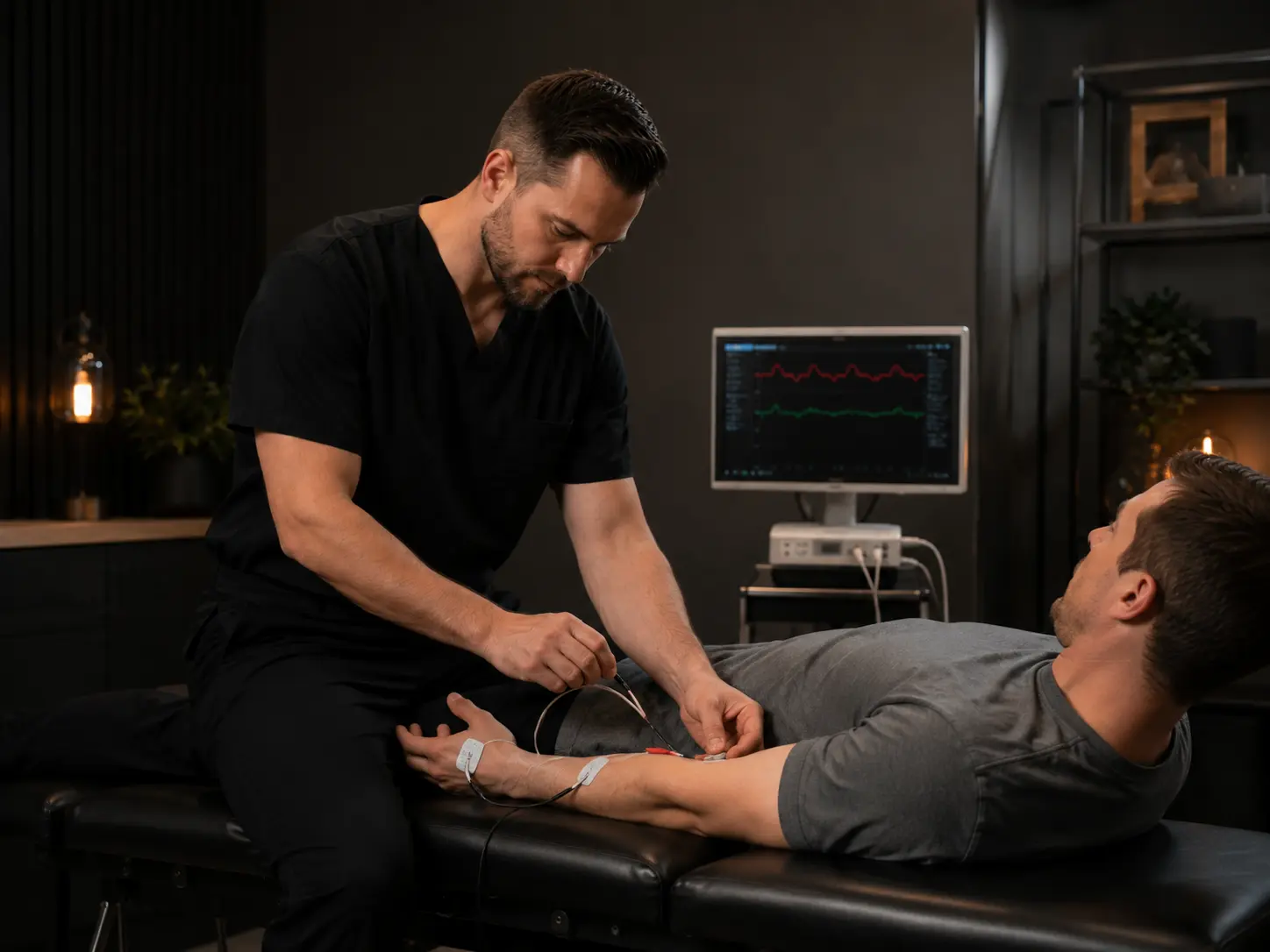
- How it's done Small sticky pads are placed on your skin, and brief, mild electrical pulses are sent along the nerve.
- What it feels like Quick tapping or tingling sensations, similar to a static shock. Each pulse lasts a fraction of a second.
- What it shows How fast and how strongly your nerves carry signals, which can reveal nerve damage or compression.
Electromyography
- How it's done A very thin needle electrode is placed in a few selected muscles to record their electrical activity at rest and when you tighten them.
- What it feels like A brief pinch when the needle goes in, and sometimes mild soreness in the muscle for a day or so.
- What it shows Whether muscles are getting normal signals from their nerves, which helps pinpoint where a nerve is injured.
What to Expect
-
1
Evaluation
One of our providers examines you and decides whether nerve and muscle testing is needed.
-
2
The Test
Done right here in our office, and usually finished in under an hour.
-
3
Results
The findings are shared with your treating providers to guide your plan and added to your medical records.
Covered for No-Fault, Workers' Comp & Personal Injury
EMG and NCV testing is billed to no-fault or workers' compensation, or handled on a lien with your attorney for personal injury cases. Coverage depends on your claim, and some workers' comp testing needs authorization from the Workers' Compensation Board first. Testing is not offered to self-pay patients at this time.
EMG & NCV Testing FAQ
Does EMG or NCV testing hurt?
Most people find it uncomfortable rather than painful. The nerve conduction study feels like quick taps or tingles, and the EMG needle causes a brief pinch. Some people have mild muscle soreness for a day or so afterward.
How long does the test take?
Usually under an hour, depending on how many areas need to be checked.
How should I prepare?
Shower on the day of the test and don't put lotion, cream, or oil on your skin. Wear loose clothing. Let us know ahead of time if you take blood thinners or have a pacemaker or other implanted device.
Can I have the test if I have a pacemaker or other implanted device?
Tell us before your test. Your provider will review your device and decide whether testing is safe for you and how it should be done.
What if I take blood thinners?
Tell us before your test. Blood thinners can make bruising from the EMG needle more likely, so your provider will decide how to proceed. Don't stop taking any medication unless the doctor who prescribed it tells you to.
Can I have the test if I'm pregnant?
Tell us if you are pregnant or might be. Your provider will decide whether testing should go ahead now or wait.
Why do I need this if I already had an MRI?
An MRI shows structure, such as a herniated disc. EMG and NCV show whether a nerve is actually being affected and how much. Together they give your providers a fuller picture.
Do I need a referral?
No outside referral is needed. Testing is recommended after an evaluation with one of our providers.
Is testing covered by insurance?
Yes, for car accident, work injury, and personal injury patients, and our office handles any authorization needed. It isn't offered as a self-pay service.
Can I go back to my normal activities afterward?
Yes. Most people return to their usual activities right after the test, including driving.
Schedule an Evaluation
No referral needed. Testing available at both offices.
Are you an attorney? Refer a client →